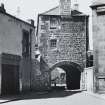
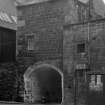
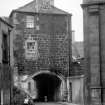
Edinburgh, Leith, Dock Street, Johnston Street, Citadel Arch
You may copy, display, store and make derivative works for personal use or use solely within an educational institution by staff and students, under these conditions: the ScotlandsPlaces website is attributed, there is no commercial use or sale, and no public distribution (for example, by hand, email, or web). Full licence details.
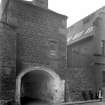
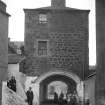
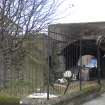
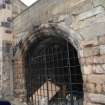
Edinburgh, Leith, Dock Street, Citadel. General view of the archway. Copyright RCAHMSItem SC610477
Organisation
The Royal Commission on the Ancient and Historical Monuments of Scotland
Alternative Name(s)CITADEL OF LEITH; LEITH CITADEL; CROMWELLIAN FORT
Canmore ID51917
Site TypeARTILLERY FORTIFICATION
CountyMIDLOTHIAN
ParishEDINBURGH (EDINBURGH, CITY OF)
CouncilEDINBURGH, CITY OF
NGRNT 26782 76615
Latitude, Longitude55.976915N, 3.174845W
Images
Archaeological Notes
NT27NE 10 26782 76615
(NT 2678 7661) Citadel Port (NR)
Citadel (NR) (remains of)
OS 6" map, Edinburghshire, 1st ed., (1853).
For discovery or discoveries of bronze axes (possibly a hoard) near the citadel, see NT27NE 16.
For indeterminate 'Roman' remains (found 1825, 'in the neighbourhood of the Citadel'), see NT27NE 23.
For 2004 discovery of part of the course of the Leith Citadel ditch and revetment wall (at NT 267 765), see NT27NE 1555.
After the battle of Dunbar in 1650, Cromwell took possession of Leith and introduced a number of English settlers. For their protection, General Monk erected a citadel at the NW corner of North Leith, partly on the parish burial ground. (see NT27NE 9).
According to Maitland (1753) it was pentagonal in shape with a bastion at each corner and one gateway, facing E. Arnot (1788) writing in 1779, notes that apart from "a strong gate with portcullices" most of the Citadel had already been demolished. The substructure of this gate still survives, giving access from Dock Street to Johnstone Street. It consists of a vaulted pend, with an arched gateway at either end. The gateway to the NE has provision for a double door, no doubt the "portcullices" mentioned by Arnot. The superstructure has been rebuilt as a house of two storeys.
W Maitland 1753; H Arnot 1788; RCAHMS 1951.
No change from previous information.
Visited by OS (B S) 27 November 1975.
The parapet is a conjectured reconstruction by Edinburgh City Architect's Department, 1964.
J Gifford, C McWilliam and D Walker 1984.
NT 2674 7654 The projected route of the Leith Citadel ditch and revetment wall (NT27NE 10) was found during an evaluation between November 2004 and January 2005. Evidence of later stone robbing from the revetment wall was also recorded. In addition, buried garden soils possibly dating to the 17th century were seen to exist in the NE part of the site. Earlier coastal deposits also survived on site. No evidence was encountered of structures within the Citadel.
Archive to be deposited in NMRS.
Sponsor: Hart Estates Ltd.
E Hindmarch 2005.
NT27NE 10 26782 76615
(NT 2678 7661) Citadel Port (NR)
Citadel (NR) (remains of)
OS 6" map, Edinburghshire, 1st ed., (1853).
For discovery or discoveries of bronze axes (possibly a hoard) near the citadel, see NT27NE 16.
For indeterminate 'Roman' remains (found 1825, 'in the neighbourhood of the Citadel'), see NT27NE 23.
For 2004 discovery of part of the course of the Leith Citadel ditch and revetment wall (at NT 267 765), see NT27NE 1555.
After the battle of Dunbar in 1650, Cromwell took possession of Leith and introduced a number of English settlers. For their protection, General Monk erected a citadel at the NW corner of North Leith, partly on the parish burial ground. (see NT27NE 9).
According to Maitland (1753) it was pentagonal in shape with a bastion at each corner and one gateway, facing E. Arnot (1788) writing in 1779, notes that apart from "a strong gate with portcullices" most of the Citadel had already been demolished. The substructure of this gate still survives, giving access from Dock Street to Johnstone Street. It consists of a vaulted pend, with an arched gateway at either end. The gateway to the NE has provision for a double door, no doubt the "portcullices" mentioned by Arnot. The superstructure has been rebuilt as a house of two storeys.
W Maitland 1753; H Arnot 1788; RCAHMS 1951.
No change from previous information.
Visited by OS (B S) 27 November 1975.
The parapet is a conjectured reconstruction by Edinburgh City Architect's Department, 1964.
J Gifford, C McWilliam and D Walker 1984.
NT 2674 7654 The projected route of the Leith Citadel ditch and revetment wall (NT27NE 10) was found during an evaluation between November 2004 and January 2005. Evidence of later stone robbing from the revetment wall was also recorded. In addition, buried garden soils possibly dating to the 17th century were seen to exist in the NE part of the site. Earlier coastal deposits also survived on site. No evidence was encountered of structures within the Citadel.
Archive to be deposited in NMRS.
Sponsor: Hart Estates Ltd.
E Hindmarch 2005.
Architectural Notes
NT27NE 10 26782 76615
Also known as Cromwell Barracks, built about 1656 by General Monk.
Demolished c.1948 to make way for industrial development.
Historical file.
"The Citadel Leith"
- 1 Drawing by Rollo.
- 1 News cutting.
In the National Library of Scotland, Vol.II., No 37, of Water Colour Sketches by Thomas Brown, Advocate, is a view in this Street. It seems to show the Citadel Port. Reference "Adv. MSS. 34.8.1-3"
See under "Water colour Sketches, series of, by Thomas Brown, Advocate".
Edinburgh, Leith, Citadel Feuing.
James Gillespie Graham.
Leith, lands at the Citadel. Feuing plan, 1807.
(Edinburgh Evening Courant, Feb 14, 1807).
Sources: Dean of Guild 2.6.1814
Pet. John Martin, Merchant in Queensferry.
Corner tenement fronting the Citadel of Leith, near to the West end of therof - - precise location unknown at time of upgrade, 8.2.2000
Minor alterations - door
NT27NE 10 26782 76615
Also known as Cromwell Barracks, built about 1656 by General Monk.
Demolished c.1948 to make way for industrial development.
Historical file.
"The Citadel Leith"
- 1 Drawing by Rollo.
- 1 News cutting.
In the National Library of Scotland, Vol.II., No 37, of Water Colour Sketches by Thomas Brown, Advocate, is a view in this Street. It seems to show the Citadel Port. Reference "Adv. MSS. 34.8.1-3"
See under "Water colour Sketches, series of, by Thomas Brown, Advocate".
Edinburgh, Leith, Citadel Feuing.
James Gillespie Graham.
Leith, lands at the Citadel. Feuing plan, 1807.
(Edinburgh Evening Courant, Feb 14, 1807).
Sources: Dean of Guild 2.6.1814
Pet. John Martin, Merchant in Queensferry.
Corner tenement fronting the Citadel of Leith, near to the West end of therof - - precise location unknown at time of upgrade, 8.2.2000
Minor alterations - door