ScotlandsPlaces Home

Scotlands Places

Dunduff


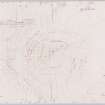
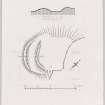
  • RCAHMS pencil plane table survey plan and profile drawing, and half size reduction. RCAHMS Date 8/9/1955 Copyright RCAHMS
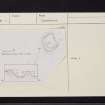
  • RCAHMS inked plan and profile, RCAHMS Date 1955 Copyright RCAHMS


You may copy, display, store and make derivative works for personal use or use solely within an educational institution by staff and students, under these conditions: the ScotlandsPlaces website is attributed, there is no commercial use or sale, and no public distribution (for example, by hand, email, or web). Full licence details.

RCAHMS pencil plane table survey plan and profile drawing, and half size reduction. RCAHMS Date 8/9/1955 Copyright RCAHMS
Item DP147613

Organisation

The Royal Commission on the Ancient and Historical Monuments of Scotland

Canmore ID

40936

Site Type

EARTHWORK

County

AYRSHIRE

Parish

MAYBOLE

Council

SOUTH AYRSHIRE

NGR

NS 2700 1635

Latitude, Longitude

55.41046N, 4.734258W

Images

Archaeological Notes
NS21NE 6 2700 1635.

(NS 2700 1635) Fort (NR)
OS 6" map (1970)

There is a fort (Smith) or enclosure (NSA) near Dunduff Castle. A rocky knoll, locally called the Danes' Hill, has two ramparts and a medial ditch drawn round its SW end. The area of the fort is 37 paces by 52; its surface is very irregular, and its sides are precipitous and rocky, except next to the rampart.
J Smith 1895; NSA 1845 (G Gray)

This fort is as described. The remains comprise a broad, flat-bottomed ditch with a high outer rampart and a lesser one on the SW side of the fort above the scarp of the ditch. The latter stands 1.0m above the interior of the fort in one place, but elsewhere it is only a course of stones for a short distance to the S. The outer rampart is 2.0m high. There are no traces of any fortifications above the craggy slopes on the N and E. The entrance was probably from the W where there is a gradual slope leading to a break in the ramparts. Any possible outer ditch has been obliterated by ploughing.
Visible on APs (540/680/3073-4).
Surveyed at 1:2500.
Visited by OS (JLD) 13 December 1955 and (RD) 14 March 1967

This may have been an early medieval ring-work.
E J Talbot 1974

This fort is basically as described above and measures internaly some 50.0m N-S by 35.0m transversely. The medial ditch on the W side is flat-bottomed and must once have been considerably deeper; it extended northwards to meet the steep rockface along the N side. The interior is undulating with protruding living rock in places but is otherwise featureless. The steep rockfaces provide natural defences on three sides. The entrance is not evident but it was probably on the W side
(cf NS20NE 6 and NX18NW 12).
Revised at 1:2500.
Visited by OS (JRL) 22 July 1977

This earthwork is situated on a rocky knoll 170m W of Dunduff Castle. The only visible defences are on the SW, where there are twin ramparts with a medial ditch, but elsewhere the earthwork is protected by steep rocky slopes. On the WSW the inner rampart measures up to 4.7m in thickness by 1m in height; to the S, however, it has been reduced to little more than a scarp, and to the N it stops 12m short of the rocky outcrop that forms the NW side of the knoll, possibly marking the site of the entrance. The ditch is flat-bottomed, measuring up to 9.2m in breadth by 0.9m in depth, and its inner lip, a scarp about 0.6m high, runs past the gap in the inner rampart unbroken. The outer rampart measures up to 7.9m in thickness by 1.3m in height. The interior measures about 43m from NNW to SSE by 28m transversely. There is no evidence to support the suggestion that this is a medieval ring-work (Talbot 1975) and the date and purpose of the earthwork are unknown.
RCAHMS 1985, visited (SH) March 1985

Related Material Information - Bibliographical References


NSA (1834-1845) The new statistical account of Scotland by the ministers of the respective parishes under the superintendence of a committee of the society for the benefit of the sons and daughters of the clergy, Edinburgh. Held at RCAHMS: B.2.2.STA
RCAHMS (1942-3) Emergency Survey 1942-3. Two volumes of typed site descriptions organised by county and parish, with handwritten editorial notes by Angus Graham dated 1960. The majority were written by Graham, some by VG Childe. Occasional references to plans and photographs which are in the manuscript and photographic collections (MS36 and county run respectively). Entries vary from short notes to lengthy multi-descriptions. Held at RCAHMS: A.1.1.SUR
RCAHMS (1950-9) Marginal Land Survey, typed site descriptions organised by county. Includes, in some cases, drafts, later notes and sketches. Principal authors KA Steer and RW Feachem. Entries vary from short notes to lengthy and detailed descriptions with reference to the associated surveys. Held at RCAHMS: A.1.1.MAR
RCAHMS (1985) The Royal Commission on the Ancient and Historical Monuments of Scotland. The archaeological sites and monuments of North Kyle, Kyle and Carrick District, Strathclyde Region, Edinburgh. Held at RCAHMS: A.1.2.ARC/25
Smith, J (1895) Prehistoric man in Ayrshire, London. Held at RCAHMS: E.2.1.SMI
Talbot, E [J] (1975) 'Early Scottish castles of earth and timber - recent field-work and excavation',

Related Material Information - Description of Collections


Digital Images

DP147613 (8/9/1955)
RCAHMS pencil plane table survey plan and profile drawing, and half size reduction. collection RCAHMS
DP147608 (1955)
RCAHMS inked plan and profile, collection RCAHMS

Manuscripts

MS36/174 (24/5/1952)
RCAHMS Investigator's Notebook. 'S7 - Ayr, Wigtown'. K Steer. collection RCAHMS

Photographs

AYD11/1P (1955)
Photographic copy of RCAHMS inked plan, collection RCAHMS

Prints And Drawings

AYD11/1 (1955)
RCAHMS Marginal Land Survey inked plan and section. collection RCAHMS
AYD11/2 (8/9/1955)
RCAHMS pencil plane table survey plan and profile drawing, and half size reduction. RCAHMS collection RCAHMS

Related OS 6-inch maps


Related OS 25-inch maps
